Buying Your First Guitar: The Essential Checklist

Updated: Aug 11

Walking into a music store as a beginner can be overwhelming. Rows full of shimmering instruments, each with a promise. How do you distinguish between a great one and a potential problem? This guide and inspection checklist will give you the confidence to evaluate just that.
Where to Buy
I strongly recommend buying from a good music store rather than some online marketplace. Reasons being:
The guitars they stock usually hit a baseline quality at the very least. They offer much better discounts, pre and after sales support.
You get to hold and sit with the instrument, which always beats online shopping. If accessibility is an issue, most good stores have online fronts which are safe to use.
They have strong ties with distributors and are quick to resolve issues or get you replacements. Overall, you’ll be in safer hands.
A lot of beginners end up not pursuing music because they are unsure of the commitment. I suggest buying with a 15 or 30 day return policy, making it a risk-free investment.
Guitar Type, Size and Brand
As you might know, acoustic and electric are the two most common types of guitars. Buying a steel string acoustic guitar is the most logical decision for a beginner, as it requires less investment, is easy to carry around, and doesn't require an amplifier to project sound. If your interest is in classical or flamenco music, opt for a nylon string acoustic guitar.
While adults should go for a full-scale guitar, kids can choose from a couple of options depending on their age:

As for the brand, it’s advisable to stick to industry leaders in the affordable price segment: Yamaha, Ibanez, Cort, Fender, and Epiphone. These companies have achieved economies of scale and are able to offer good quality at a fantastic price. Moreover, building guitars the right way is a complicated process. They have the know-how, given the decades of experience.
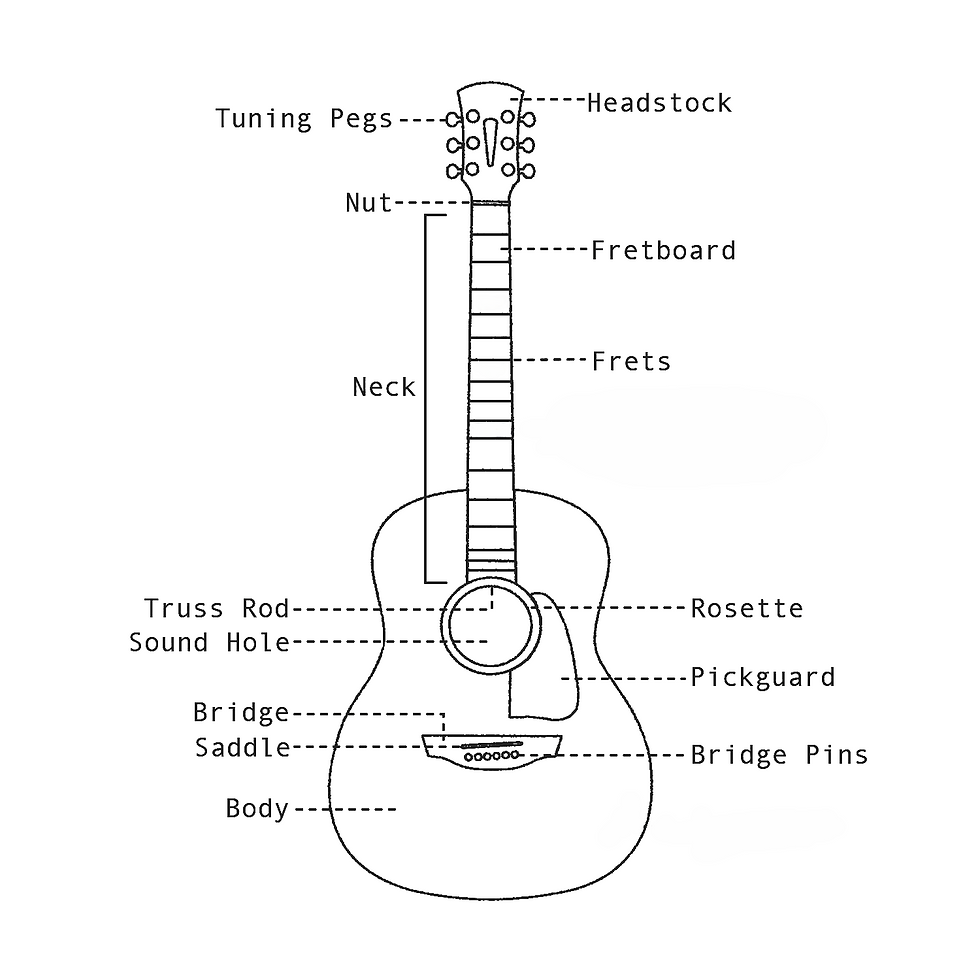
Before we move on, here is a guitar parts diagram for your reference:
The Guitar Buying Checklist
So, you have made it to a store, and the sales representative has handed you a fine-looking guitar that fits the bill. What next?
Here are the things you need to check for:
Structural Integrity: Guitars are affected by changes in relative humidity and temperature. Even the ones that come out perfect from the factory can develop problems during transit or due to incorrect storage. Dryness can cause the wood to shrink and crack, while excessive heat and humidity can weaken the glue joints.
Inspect for any cracks in the wood and look for air gaps between joints. Take a piece of paper and try to slide it under the bridge. If it goes through, it means the bridge is not securely glued to the top. Inspect for air gaps where the neck meets the body and around the nut. Overall, everything should be secure and well fitted.

Bridge lifting from the top The Neck: Guitar necks are crafted straight, but bend under string tension as they experience a pull of up to 80kgs. In order to counteract this force, a metal rod is inserted inside the neck, knows as the truss rod.
Ask the in-house guitar tech to adjust the neck until it is almost straight. After adjusting, visually inspect for any obvious bends, twists, or kinks. The slightest amount of forward bow is desirable (also called relief), but significant warping indicates serious problems.

Fretwork: Changes in relative humidity and temperature can cause the neck of a guitar to shrink, while the frets don't. This can result in protruding fret ends that are sharp enough to cut through your fingers. Carefully glide your hand around the fret edges to inspect this.

A protruding fret end Also inspect for frets that look raised and aren’t seated properly in their slots. These are a strict no.

An unseated fret Now ask the guitar tech to check for dead spots by playing the strings on each fret. This happens when something is preventing the natural movement of the string, resulting in a dead sound.
String Height: The distance between the strings and the frets is critical for an easy playing guitar, as even a well-crafted one will feel unplayable with a very high action.
To check the height at the nut, press the strings at the second fret and observe the gap between the string and the first fret. Ideally, this gap should be as little as possible. A large gap indicates that the nut is cut too high.

Ideal height at the nut The height of the strings at the 12th fret is usually set between: 1.2–1.6mm for the 1st string, 1.6–2.0mm for the 6th string. You can ask the guitar tech to measure this distance. If it’s too high, they will be able to reduce it by sanding the saddle.

Measuring with a ruler Sound Quality and Playing Feel: It will be difficult to assess these unless you have some experience. Don't hesitate to ask someone in the store if they can play the guitar and show you how it sounds. They can also check if the tuning pegs are operating smoothly and the guitar is holding its tuning.
The Big Day
For my final suggestion: make a day out of it and have some fun!
Bring along a friend or go solo. See which guitar you are naturally drawn towards.
Trust your gut—and this guide—and you’ll be all set.
Useful Links
Sweetwater Guide: https://www.sweetwater.com/insync/acoustic-guitar-buying-guide/
Great job on this detailed checklist! Your tips are super practical and I’m sure they’ll help a lot of people make better choices when buying a guitar.